As Filipinos we are a very creative and artistic group of people. Drive around Manila and you will see random walls painted in beautiful mural works of art ranging from illustrations of well known historical figures, to depicting social and political issues. The art scene in the Philippines isn’t as known as other places in the world, however art history in the country still exists and extends to our pre-colonial art.
When you think of art from the Philippines, one mainly thinks of paintings such as the pieces done by Fernando Amorsolo and Carlos V. Francisco. Others turn to literary works of art such as Jose Rizal’s infamous Noli Me Tangere, while others lean toward our indigenous textiles and weaving. Most of these pieces you can all see close up in the National History Museum of the Philippines in their art gallery.
However, what the majority of people don’t know, is that we do have some stunning and historically invigorating works of ancient art that aren’t appreciated enough, that gives insight to our pre-colonial past. These archaeological finds were made by our ancestors long ago and depict the artistic talents of their time. Some signify important rites of passage through life and death, while others are so intricate that the method used to make them have long been forgotten in history.
Let us take a look through these 5 works of ancient art from the Philippines that each tell a story of a past many strive to learn and remember. A past that invigorates us to explore how these ancient artists saw the world to make something special, an idea that hasn’t changed in over a thousand years.
1.) The Manunggul Jar


The manunggul jar is an extraordinary work of art fueled by indigenous spiritual beliefs of life after death. This second burial jar was discovered on March 1964 in Manunngul Cave in Lipuun Point, Quezon, Palawan by Victor Decalan, Hans Kasten and several volunteer workers from the United States Peace Corps and archaeologists from the National Museum. It has been dated to the Neolithic Period around 890-710 B.C. and depicts two human figures on a boat on the jar cover. The figure on the back is the boatman paddling the ship with the figure in front being the dead soul as depicted by their hands folded across their chest, a position still widely practiced in the arrangement of the dead.
The jar also shows curved lines representing waves of water, a motif of importance in indigenous beliefs and cosmology. In old precolonial beliefs a connection between bodies of water and the afterlife is found throughout the Philippines. In the Bisayas, it was believed that the Goddess Magwayan ferried the dead on her boat across the spiritual river, Lalangban, to Sulad, a purgatory, to finally Saad, the resting place of the dead ancestors. Throughout the Philippines there is also the belief between the upstream and downstream in many cosmologies where the upstream represents birth and life where as the downstream of the river represents death and the afterlife where we return to the sea which brought us to the islands. The Manunngul Jar shows the importance of burial practices and the spiritual beliefs among our early ancestors on the afterlife. It is a symbolic and archaeological evidence of the strong indigenous spirituality in precolonial Philippines. The Manunggul Burial Jar is currently housed in the Museum of the Filipino People, by the National Museum of the Philippines in Manila.
2) The Maitum Anthropomorphic Burial Jars


Discovered in 1991 in Ayub Cave, in Pinol, Maitum, Sarangani Province in Mindanao, and dated to the Metal Age through radio carbon dating. The jars are unique, each one not being the same as another. It signifies that these jars represents different individual ancestors in history, as each anthropomorphic pottery jar have individual and distinctive features. Some have earrings, long lobes, tattoos, a variety of facial expressions, and a few also have arms, legs, and sexual organs. These different human figures may have been visual representations of the deceased themselves, where their remains were left inside the jar to be guarded. These 27 different jars are intriguing to the eye, a representation of the human spirit even in death. Let their faces watch you.
3.) The Angono Petroglyphs


Last September I had the pleasure of visiting the site of the Angono Petroglyphs in Binangonan, Rizal. Without me even knowing it, I didn’t realize how close the site was to where my tita and tito lived until we passed by a sign reading Angono Petroglyphs as we were driving to their house. It was unfortunate how they didn’t seem to know what I was talking about when I mentioned I wanted to visit the site, despite them living in such close proximity.
Often forgotten even among local, the Angono Petroglyphs are one of the most important archaeological sites and one of the earliest known works of art in the country. Unfortunately, it is also close to disappearing due to erosion and vandalism. The Angono Petroglyphs are the oldest known work of art dating to at least 3000 B.C. that depicts 127 carved stick drawings of human figures and animals on the walls. It was discovered by Carlos V. Francisco, a local mural painter and National Artist of the Philippines awardee, who was leading a Boy Scout troop hike in 1965.
Despite over 50 years since its discovery, not much research has been done on the petroglyphs and we don’t know too much on who the people were that carved these figures and why. It is presumed to have been a place of worship however, based on the illustrations on the walls of humans in an orant position with their arms being raised.
Currently there is no one really doing a study of the petroglyphs and the site in detail based on my interview with one of the National Museum workers who was on site repairing the small building that is the museum, who was excited and passionate about the site based on our discussion. He believes, as well as myself, that there are more like the one in Binangonan to be discovered nearby, however without any support from the government and people eager to excavate and study the area, finding them at this point in time is hopeless. What isn’t hopeless however, is studying the site, the petroglyphs, and preserving them before they disappear forever. Because the Angono Petroglyphs aren’t just a “cave drawing” by people thousands of years ago, but a testament to our pre-colonial history, and how our early ancestors saw their world, took an initiative to tell their stories, and record it through these petroglyphs.
4.) Tattooing


Not an archaeological artifact per se, but tattooing among our ancestors was both a work of art and a spiritual act. Tattooing in the Philippines was once a prestigious rite of passage, one that was earned through bravery and through puberty. When the Spaniards first arrived they noticed the people they met were covered in beautiful black designs that were permanently “painted” on their contrasting brown skin. They mentioned how these designs were another form of clothing to our ancestors, one they took pride in. Not knowing the name of the people they came across at the time they referred to these people they met across the Bisayan islands as The Pintados or “The Painted Ones” for their elaborate and stunning tattoo’s on both men and women. Notable illustrations of these early Bisayans can be found in Francisco Alcina’s Historia de las islas e indios de Bisayas (1668) and in the most well known manuscript on early Asian history during the 16th century, the Boxer Codex (c. 1590).
While we do not have any mummified remains of these Pintados, the illustrations and descriptions of some designs, such as the labid – distinctive inch-wide lines both straight & zigzaged up the legs to the waist; and langi – face mask like a crocodile jaws, motifs give us an idea of how these tattooed warriors looked like in their glory.
5.) Goldwork


The most often discussed subject among the Spaniards involving the islands was gold, the rich amounts of it found, and the detailed motifs, as well as creativity used by our early ancestors. The conquistadors were well known to have a keen interest in gold throughout their history of colonization, the Philippines being no exception.
Gold mines were found throughout the islands and the abundance of it was enough that our ancestors never took more than what was needed. It puzzled the Spaniards, that despite the rich deposits of gold, they didn’t bother mining the gold with as much force as the Spaniards would have liked and done. Based on historical accounts, our early ancestors had no problem with this, as the statement of gold being found everywhere was no exaggeration.
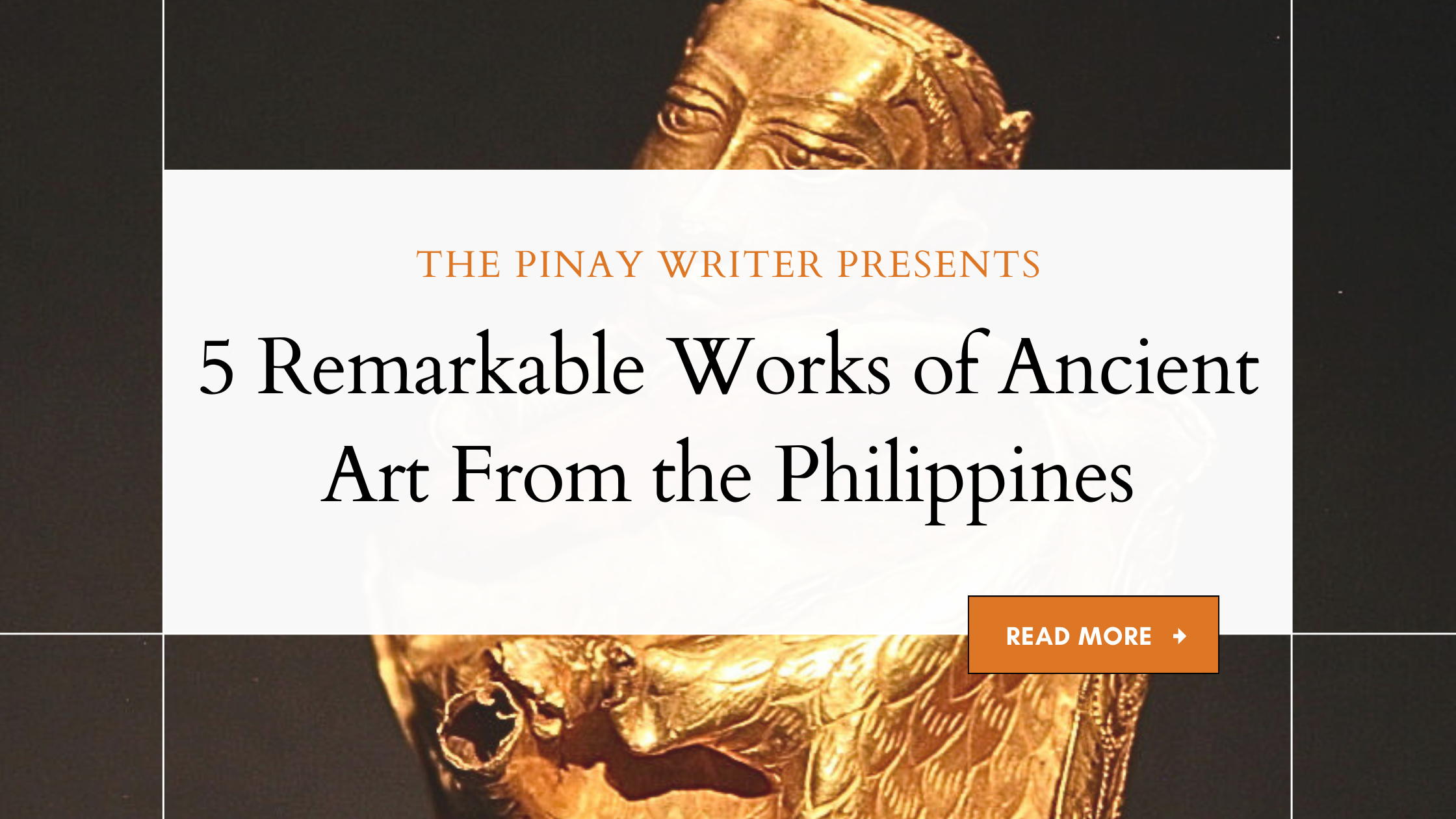
It was literally everywhere, and everyone from the slaves to the nobility had possession of gold on them. Most of this gold was in the form of jewelry such as necklaces, rings, armlets, and rings that were passed down from generation to generation as heirlooms called bahandi. For those who could afford it or were given these pieces as gifts, to annual raids along the coasts, they received gold dagger handles, gold bowls, drinking vessels, religious figures of deities, gold belts, and even from one recovered artifact, a golden sash. Even in death along with their possessions, gold death masks were used to cover their eyes, nose, mouth, or entire face. The craftsmanship of some of these gold products were so sophisticated and of high quality, many of the Spaniards praised them for it, often remarking how the gold work and skills used were of greater value than expected of a people they thought of as ‘uncivilized’.
The early people of the Philippines were so skilled they managed to created pieces of artwork through this historical prized metal. They could carve, hammer, and mold it out to how they wanted. They were even able to develop an artistic technique where they were able to create very fine and thin gold wires and beads to be woven like fabric to create pieces such as thick rope like sashes and intricate jewelry. The goldsmiths of the time were so skilled and their artistry continues to amaze people today through the recovered works of art over the years.