What is Undas? Dáun? Kalag Kalag?
Celebrating and Remembering the Dead
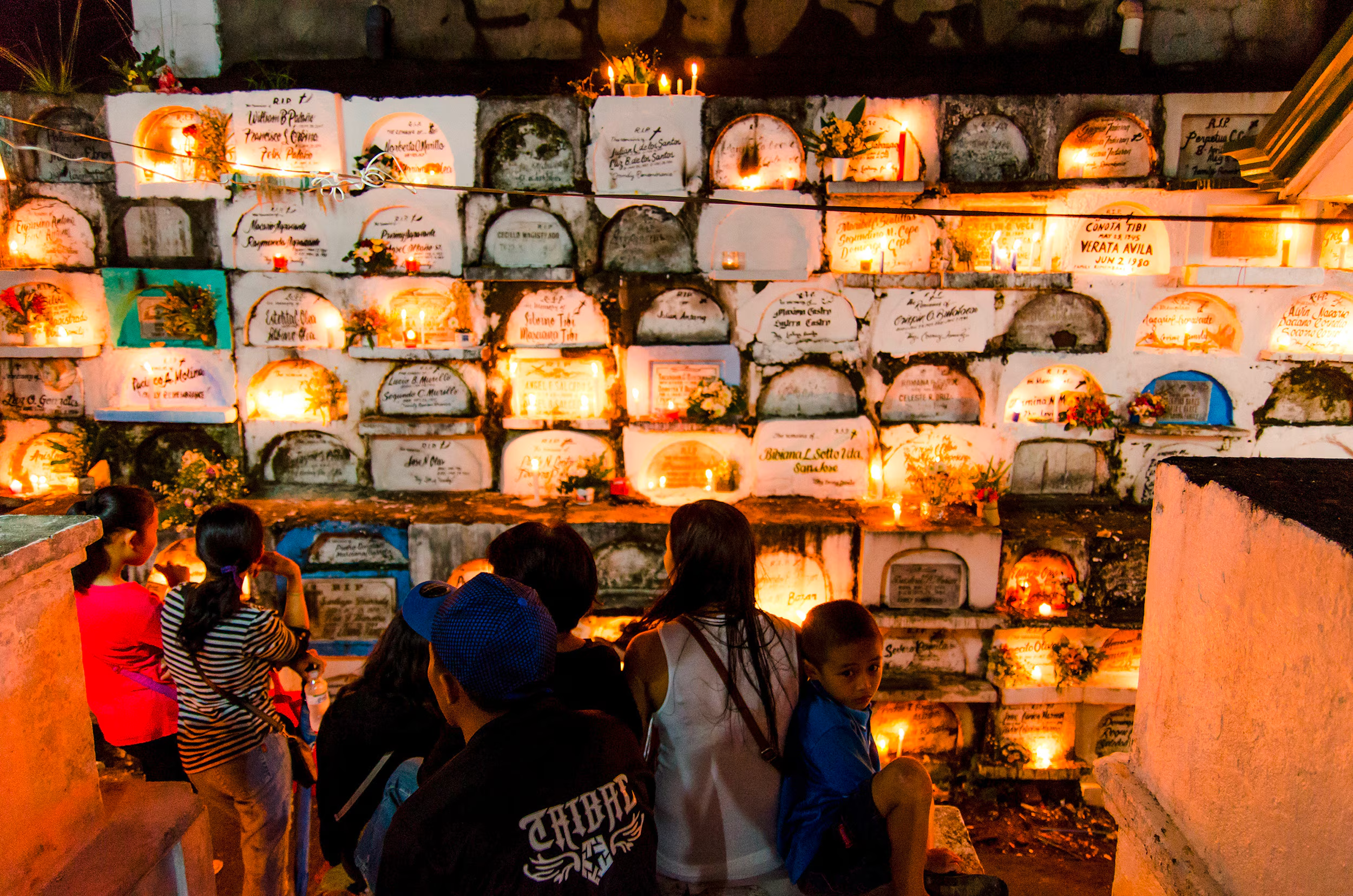
From November 1-2, many Filipino families will be heading back home to celebrate and pay respects to the dead. Cemeteries will be filled with the living as they visit and decorate the graves of their departed loved ones. They will be cleaning the grave stones, decorating them with flowers, candles, and giving food offerings. While the idea of death is solemn, laughter can usually be heard as the memories of those who have passed on are spoken and remembered among family and friends. Hymns and songs can sometimes be heard, as families sit together around the graves in celebration and in honor of the spirits of the dead. They will also eat and have drinks, inviting the spirits to join them.
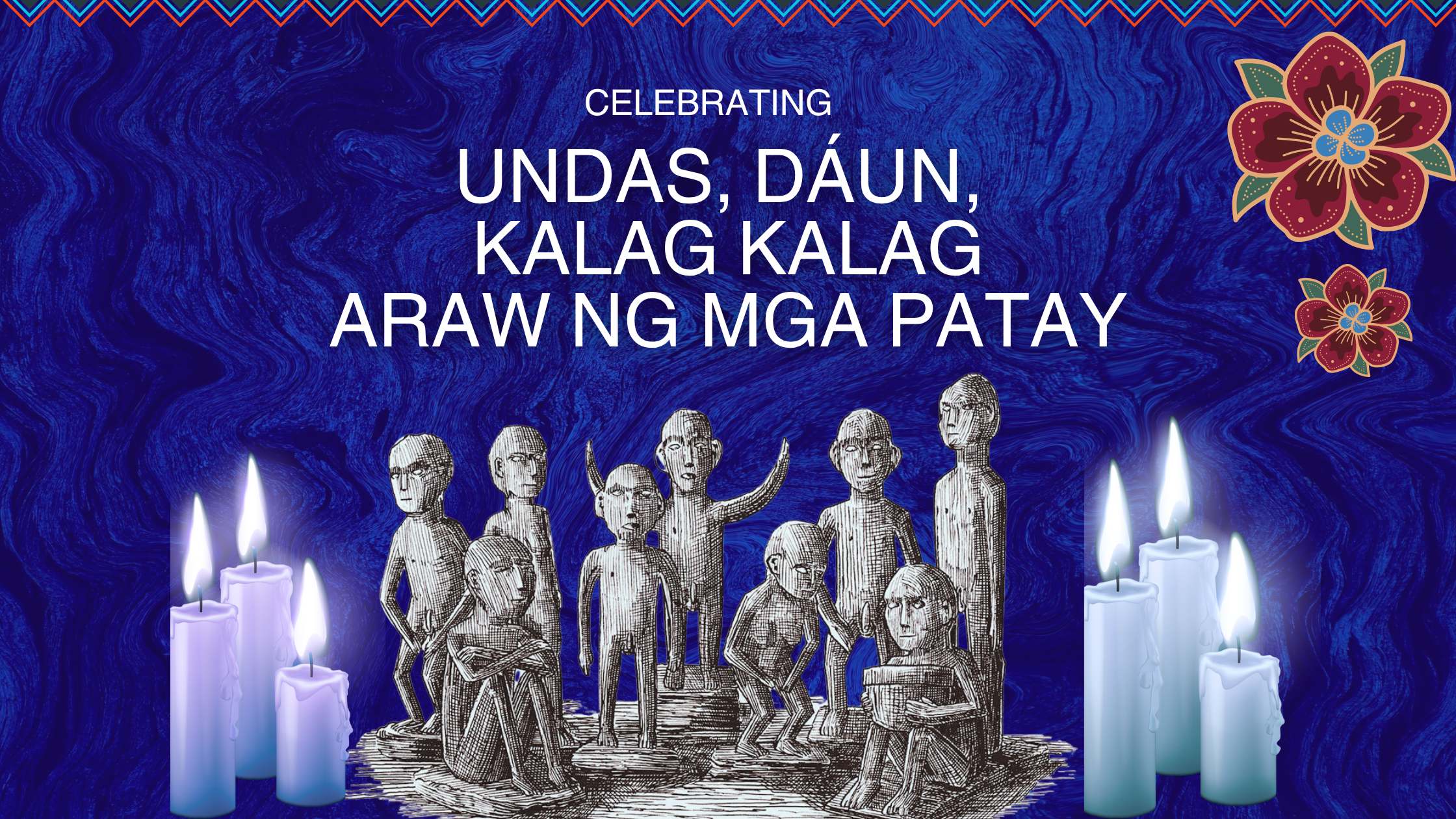
All Saints and All Souls Day, or Araw ng mga Patay is celebrated among Filipinos every year. Other names for the holiday are Undas among the Tagalog, Pistang Kalag (Festival of Souls) among the Bikolano, Dáun for the Kapampangan, Kalag-Kalag for the Bisayans, Undras among the Tagalog of Mindoro & Batangas, and Pista’y Inatey for the Pangasinense. Similar to Dia de los Muertos in Mexico, while the date of the celebration might have been influenced during Spanish colonization, the celebration stems from pre-colonial practices of annually celebrating the dead on the anniversary of their death.

When the holiday was introduced by the Spaniards, the concept of paying our respects for the dead was not new. They would have yearly celebrations of the dead on the anniversary of someone’s death. Food offerings were given and they dressed and anointed the figures carved in their memory. Altars were decorated with flowers and the deceased loved ones would come together and honor, remember the life of the person they were celebrating. Sharing stories and memories.
In this article, we will discuss and learn about the pre-colonial practices and beliefs regarding the spirits and ancestors, food offerings, altars, shrines, and how we can celebrate this holiday.
Beliefs and Practices for Undas, Dáun, Kalag-Kalag
There are some beliefs and practices currently believed in and observed during Undas. Whenever it rains on Undas, it’s believed that they are the tears of the dead. Fresh flowers, wreaths, candles, and food are laid out on top of the graves. Family members will tell stories of the dead throughout the night.
Another common practice is serenading from house to house and singing. This derives from a pre-colonial practice, where a group of mourners as part of their job, were to sing for the dead. More on this later on.
Names of those who have passed are mentioned, especially during mass. Palina, or burning of certain leaves and herbs, while stepping over it and passing through the smoke, is done when leaving the cemetery. This is done to cleanse and purify one’s self from any evil spirits and bad luck.
Traditionally, during the days leading up to Undas, people will head to the cemeteries to scrub and clean the area the headstones or tombs of their deceased loved ones. Weeds are pulled and trash are thrown out, making sure the space is clean and prepared for visitors to come by. Sometimes, if needed, they will also repaint the gravestones or tombs if needed.
When loved ones come by the gravesites, they will proceed to light candles and leave food offerings and fresh flowers. For Cebuanos, along with traditional food offering staples, they would often give sweets like biko, because it’s believed that the souls of the dead loved sweets. This ties in with some pre-colonial beliefs in certain sweet food offerings that were given to the dead. More on this is discussed in the “Food Offerings, Altars, and Shrines” section.
Another practice is called pagpag. This is the concept of not going directly home after visiting the cemetery. This is because of the belief that if you do, the spirits will come and follow you. By doing pagpag, you must go somewhere else first before going home, so you don’t invite the spirits of the dead to come to your home.
The Importance of Honoring the Ancestors
The Anito
Our ancestors were Animists and Polytheists. As Animists, they held the belief that everything, including inanimate objects, possessed a spirit. The plants, trees, rivers, mountains and celestial bodies, each being respected and revered. They believed in a spiritual realm which existed and could be entered in various ways, but is alongside ours. They also believed in a plethora of spirits, many whom roamed about and lived alongside of us. These spirits typically consisted of two types. The first type were the nature and environmental spirits, manifestations of certain rivers, trees, rocks, the sky, sea, and forests. The second type were the ancestral spirits, those who passed away and whose soul wandered the earth.
Despite years of colonization and Roman Catholicism taking root as the predominant religion in the Philippines, there is a continued understanding that these spirits are around us and can influence our daily lives. Ancestral spirits could also become nature spirits, some becoming one over time as the names of these ancestors faded away from memory. A common term for the spirits are anito.
The term anito was used with slight variations in meaning across the Philippines. For the Tagalog, it meant the spirits, deities, and ancestors. For the Ayta in Luzon, they use the term to mean beneifcent environmental spirits. The Kapampangan specifically use it to refer to the souls of the dead, and for the Bisayans, the term was used to mean sacrifice, using the term diwata instead, though specifically diwata was used to refer to the deities. Other Austronesian groups still use the word anito or its cognates to describe the same thing. For the indigenous groups in Taiwan, they use the term anito to describe ghosts and spirits, in Indonesia they use the term hantu, and in the Pacific it’s aitu.
They believed that whenever someone was sick without any logical explanation why, the sickness was caused by the anito. It was important to keep the balance between us and the spirits, as causing harm to the spirits, intentional or unintentional, is typically the cause of illness.
There is a popular phrase often muttered by those entering a new place, in particular natural environments such as an uninhabited forest, beach, land, rice field, mountain, river, etc, or when passing by a certain tree or ant/termite mound. The Tagalog phrase, “Tabi-tabi po,” is often said to the spirits, for the Ilokano it’s “Dayu-Dayu, Bari-bari”or “Kayu-kayu, Bari-bari”. These phrases, which roughly translates to “excuse me”, are uttered as a warning to the spirits in the area, letting them know that you are approaching and don’t mean any harm to them. By doing so, you are giving your respects to the spirits and preventing sickness to befall you, by avoiding to anger or provoke the spirits. For the Ilokano they will also say, “Agawiden, di ka agbatbati” when they are coming back home from a far off place, especially at night. This was done so that the soul of the person won’t be left behind and will go back home safely.
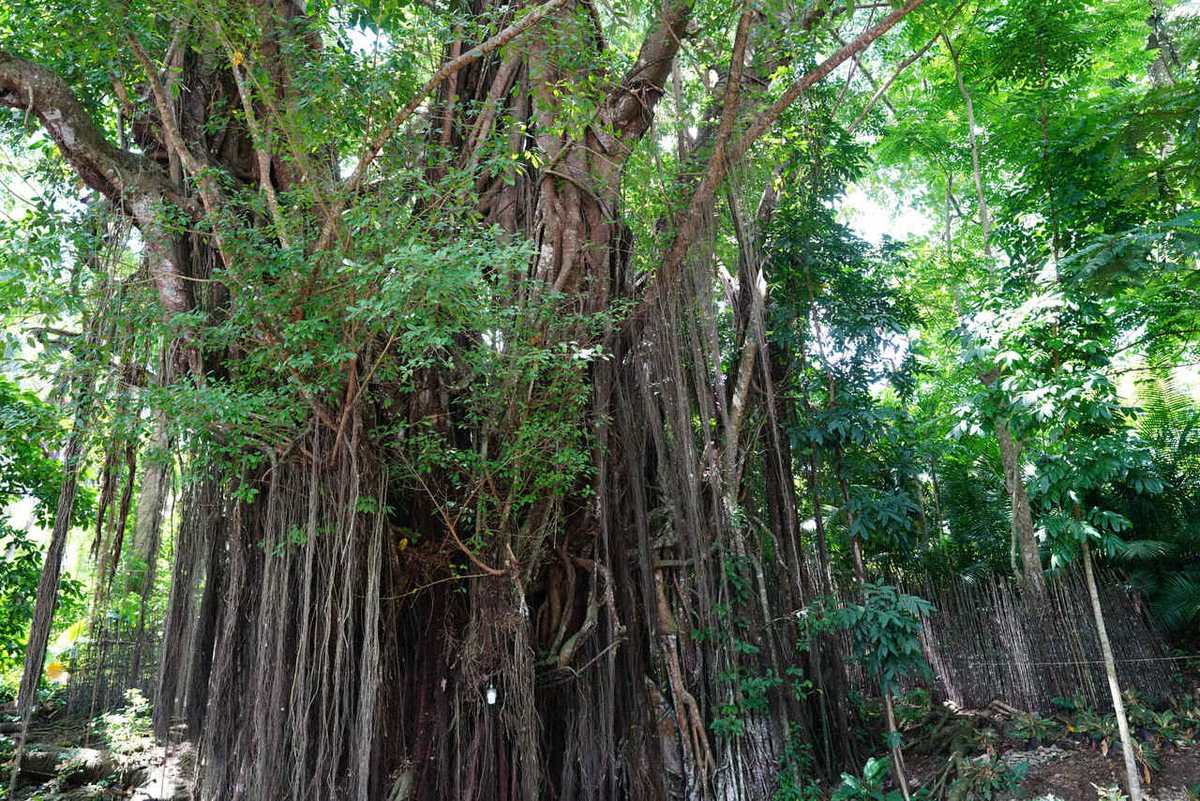
Many of these spirits also lived in certain trees such as the balete, or banyan tree, also known as lunok or dalakit in the Bisayas and Mindanao . The balete tree itself was considered to be a very spiritual place and believed to be an entryway to the spirit realm. Among the Tagalog, they believed in a specific spirit that resided in the balete tree, wherever it was. They also considered the balete or banyan tree as sacred, like many other ethnic groups in the Philippines. The Tagalog in their pre-colonial marriage practices, would carry dishes of food to the balete tree as part of a spiritual practice to give alay, or food offerings, to the spirit of the balete tree. They would also light incense to burn under the tree during the offering. Another type of spirit was the nuno sa punso (grandfather of the ant hill), or the anito of the anay (termite/ant) punso (hill). The term nuno, has two meanings, grandfather and an ancestral spirit. So the nuno sa punso that we commonly see today as a small dwarf like spirit, is actually an ancestral spirit.
In the pre-colonial belief systems in the Philippines, the reverence and remembrance of our dead ancestors held a great importance in one’s every day life. Whenever someone died, carved figures made out of common materials such as wood or stone, though sometimes out of ivory and gold, were often created in honor of the person who joined the spirit world. In one Spanish manuscript by Miguel de Loarca, he writes that after someone died, the community would come together to make a small wooden idol and preserve it.
In some places and especially in the mountain districts, when the father, mother, or other relative dies, the people unite in making a small wooden idol, and preserve it. Accordingly there is a house which contains one hundred or two hundred of these idols. These images also are called anitos; for they say that when people die, they go to serve the Batala. Therefore they make sacrifices to these anitos, offering them food, wine, and gold ornaments; and request them to be intercessors for them before the Batala, whom they regard as God.
— Relation de las Yslas Filipinas in 1582 by Miguel de Loarca
These carved figures were called likha and larawan in Tagalog, ladaoan among the Ilokano, and tao-tao for the Bisayans. The Bikolano had several terms including tango, tatawo, and parangpan, but the most common and general term was ladawan. A figure specifically used in rituals held by the balyan, the Bikolano term for priestess, were called by the Bikolano, lagdong. These figures not only were made to represent the deceased, but they were also sometimes created to host the spirit in them.

Today, beliefs in the spirits and spirit world still exist in the Philippines, especially in the provinces. There are many protocols, taboos, and what some may call superstitious beliefs regarding the spirits, what to do in order not to offend them, what to do when you do, etc.
The anito can be good or harmful. You may have heard of a relative or friend who visited a traditional healer like an abularyo, to heal the sick. While most people go to the doctor first, often times they will go to a traditional healer as they believe some ailments are caused by the spirits and the person offending or angering them. The beliefs in saying “tabi tabi po” or not to climb up a sacred tree like the balete, or kicking an ant mound, etc is because of the belief that if you do, you will anger the spirits. When an illness has no other explanation, people will go to to a traditional healer to cure them.
The Beliefs in the Soul and Ancestral Spirits
For many of the ethnic groups in the Philippines, there is a belief in having more than one soul. The number of souls differ from group to group, however the most common number of souls is two. “Duwa” and its cognates means the number two, leading to the formation of several words for soul: Kaluluwa (Tagalog), Ikaruruwa (Ibanag), Kararua (Ilokano), Karaduwa (Hanunoo Mangyan), Kaladuwa (Kapampangan). For the Bagobo, they believe that we all have two souls; each residing in a different side of the body. On the left side the bad soul resides whereas on the right it’s the good soul.
There is also a belief that some ancestral spirits turned into local deities throughout the Philippines. For the Tagalog, this would explain the concept of anito, being used to refer to the spirits of the ancestors, deities, and nature spirits. Some of these ancestral anito, or spirits, if they held a great status or were held in high regard, either by doing some good deed or something heroic, would sometimes turn into a local deity. This would also explain the two types of deities, the major or more common deities, often well known amongst throughout the same ethnic group and within different towns and villages. The second type were the ancestral spirits turned local deities, deities known only to the local town or village, but not known to other towns and villages of the same ethnic group.
Ancestral spirits could also be guardian spirits, a concept which today is seen as guardian angels in Catholicism. These guardian spirits were either born or assigned to you at birth, and followed you until death. For the Tagalog, the term for this guardian spirit was katutubo, in Bikol it was tambay or katambay, in the Bisayas it was umalagad, the Ilokano call it kadkaddua and among the Maranao it was tonong. These guardian spirits were typically ancestral spirits, but sometimes also could be nature spirits. They watched over and protected the person from both physical and spiritual harm. For some groups, this belief extended to having a twin soul who also acted as one’s guardian spirit.
In the Bisayas and other parts of the Philippines, they believed that for some people their umalagad was a twin snake. This guardian serpent was their twin spiritually and physically as during birth, the mother would conceive both the child and the snake. These individuals who had a twin snake, or kambal ahas, were believed to be lucky and were destined for success and great things. They were guided and defended by their twin snake who followed them everywhere.
One of the most famous historical accounts is told by Francisco Alcina in 1668 of his own encounter of an incident of a mother giving birth to a child with a twin snake in Samar. In the account, the mother told Alcina that when she gave birth to her child she also gave birth to a snake that was the size of the index finger and more than a palmo and a half in length [equivalent to about a foot from the old Spanish unit of length]. She described the snake as being reddish from the head to the middle of its body, followed by being black down the rest of its length. She was scared of it and tried to get it away, but the snake continued to find its way to its twin. During the third day after the child’s birth, the mother proceeded to go to the ocean to give the baby a bath. When she went to get the baby, she found the snake at the baby’s side and stretched out in the cradle. They would continue to come upon the snake several more times, sleeping and curled up with the baby boy. Eventually, fearful of the snake, the family moved away to a different town to get away from it. The belief in the kambal ahas is still widely prevalent in the Philippines and reports of those who say their child was born with a snake twin continue to be told from Pangasinan to Bulacan.
The animistic belief of everything having a spirit also extends to inanimate objects. While we generally have at least two souls, inanimate objects however typically just have one spirit. This belief in objects having a spirit can be seen in how burial practices were performed, how amulets worked, and giving offerings and asking the confirmation of the spirit of a boat or car if it’s safe to travel.
Customs for burying the dead often consisted of performing a maganito or pag-anito, to the ancestors and/or a specific deity so that the deceased would pass on peacefully and safely as they made their journey to the afterlife. Objects such as jars, porcelain plates, heirlooms or bahandi, gold ornaments, swords, and anything the deceased would need in their next life were buried with them. This was because they believed that spirits of the objects that were buried would follow the deceased.

“Of the aforesaid, it is well known that that people believed in the error that the soul went with the body, and that they were maintained in the other life as in this. Consequently, they placed the most costly clothes in the sepulchers. The relatives added others, and even arms, if the deceased was a man, and the instruments of her domestic labor if a woman, together with all the other dishes and jewels of the house (not even excepting gold and precious jewels), in accordance with their taste, so that these might be enjoyed in the other life. The food was carried to them for the space of one year, and it was placed gon an adorned table every day. When it was taken there, the food of the preceding day was taken away. That they threw into the water, and no one dared to touch it, as it was a sacred thing. They generally built a hut over the grave, so that the deceased should not suffer from the inclemency of the weather.“
— Quote describing the beliefs from the province of Cagara in Mindanao from the Historia general de los religiosos descalzos del orden de S. Augustin by Fray Luis de Jesús (Madrid, 1681)
There were also spirits of the home. For the Bikolano, the term alagad, while a guardian spirit, was known to be a guardian spirit of the home. One of their pag-anito rituals called yukod, was done in honor of the anito. It was held to secure a blessing for a favorite child and to protect them from the aswang. The yukod, was done by the balyan, who carried the child in a procession to all corners of the house, proclaiming them to be protected and under the care of the ancestral spirits.
Food Offerings, Altars, and Shrines

To the anito and diwata, food and drink offerings are often given to them out of respect. They were given to the ancestors during wakes, Kalag-Kalag, and when trying to heal the sick. They were also given to pacify the spirits.
Among our pre-colonial practices, altars and shrines were created, either permanent or makeshift, some in the home and others out in the fields or entryway to the village. On these altars and shrines one could find the carved figures of these anito and diwata. Besides having them in one’s personal home shrines, they were also found in the riverbanks and caves.
For the Tagalog, they would decorate the heads of these figures with a crown of strung flowers wrought in gold which they called sinampaga. The flowers highly possibly used, were jasmine, commonly known as sampaguita, or known by their native name, sampaga . They would decorate these figures, especially during celebratory rites, with gold, beads, and garments, then anoint them with oils.
The altars and shrines themselves were decorated and used to either house the spirits or have a space for them to come by. Lambana was the Tagalog term for their altars and oratory shrines. In Pangasinan, it was anitoan and for the Bikolano it was salagnat. There were also spirit shrines, such as the Ilokano’s dagusan and the Tagalog ulango. These spirit shrines specifically housed the anito.
When it came to offerings to the anito and diwata, these included different food, drinks and incense. These offerings are known as atang in Ilokano, alay in Tagalog, and halad or harang in various Bisayan languages. Some staple food offerings are tobacco, rice, rice cakes, eggs, fruits, pork, suman, chicken, and alcoholic drinks like tuba and pangasi. It would also commonly include betel leaves or betel nut, which was often shared among the members participating in a certain ritual. While these offerings were common, there were specific offerings for certain occasions. Other traditional food items are maruya/baduya, and patupat/puso (hanging rice cakes).
These offerings were placed on altars and shrines, usually left for the spirits untouched, while some ethnic groups like the Bikolano, would eventually consume the offerings. For the Bisayans, they considered the act of eating the food offerings meant for the spirits and deities, as taboo.

For the Tagalog, offerings included bukhayo or bukayo, a caramel-like, sweet desert which were given as an offering after a burial. According to the oldest Tagalog dictionary by San Buenaventura, they would hang a type of curtain around the grave and place bukhayo as offerings to the dead. They also gave a padugo, which was a specific offering given to a deity or spirit to ask to cure a sick person. According to the San Buenaventura dictionary, the padugo consisted of 2 chickens, one rooster and one hen, where they would marry them then ritually kill them, presenting the blood and offering to the deity or spirit. Another specific offering was called bungoy, which was also given to cure the sick, however this offering consisted of chicken or any other animal that was attached head down to a pole.
Pre-colonially, the priestesses and priests, called katalonan in Tagalog, katulunan in Kapampangan, babaylan or baylan in the Bisayas, baglan in Ilokano, bayok in Sambali, etc. would also have more elaborate ritual offerings which largely consisted of a hog that was ritually sacrificed and killed after they said their prayers and dances. The hog would then be shared with the community. This could be for large scale offerings for a good harvest for the community or in events such as asking the blessings from the ancestors, spirits and deities for a fruitful marriage. Does this sound familiar? If it does, it’s because while the spiritual aspect of it has been lost, the practice of killing a hog for healing a sick person or when having a large celebration such as a wedding, still exists and is practiced today.
Pre-colonial Beliefs in the Afterlife
Cosmology
The pre-colonial beliefs regarding the journey to the afterlife often had common themes, with a few cultural differences between the different ethnic groups. Generally, the belief is that when we die, the soul that leaves and goes to the next world is brought there by some spirit or deity. Their journey begins by passing through a spiritual river going downstream, the direction of death and the afterlife, where they are ferried on a boat to the next destination. This is in comparison with the upstream being a symbol of birth. For the Ilokano, this was sarong (upstream) and puyupoyan (downstream). Among the Kapampangan, it was paralaya (upstream) and paroba (downstream). For the Kalinga it’s daya (upstream) and lagud (downstream).
A toll of some sort was usually paid to pass through the river, along with showing one’s tattooed body. The payment consisted of items that were buried with the person, such as gold jewelry, porcelain, bahandi (heirlooms), or money that was fastened on their arms. This spiritual river that the soul journeyed on was called by different names. Lalangban among the Bisayans, Kalabegang for the Tagbanwa, and Banua ka Metum Waig , or the City of the Black River, by the Bagobo. Lalangban was also the name of a deep cave that was the entrance to the underworld.
When a man died, his soul was obliged to pass a river or lake where there was a boat rowed by an old boatman; and to pay his passage they fastened some money on the arm of the dead man. They believed that no woman could pass whose hands were not tattooed with black in accordance with their custom. They were in the habit also of burying with the dead food for the journey, oil with which he might anoint himself, a robe for his clothing, and some gold for the contingencies which might arise.
— Quote describing the beliefs of the Ibanag in Cagayan from the Historia de la provincia del Sancto Rosario de la Orden de Predicadores by Diego Aduarte, O.P.; Manila, 1640)

For the Bisayans, it was the diwata (deity), Magwayan, the primordial goddess of the sea, who ferried the souls on the river. For the Ilokano, it was the spirit, agrakrakit, and for the Tagalog, it was most likely the anito, Paalulong, the deity of the sick and dead.
We can see this widespread belief of a spirit or deity ferrying the dead to the afterlife on a representation of it in the Manunggul Jar that was found on March 1964 in Manunggul Cave in Lipuun Pioint, Quezon, Palawan by Victor Decalan, Hans Kasten and several volunteer workers from the United States Peace Corps and archaeologists from the National Museum. Believed to be a burial site, the Manunggul Jar that was discovered with many other jars, is a secondary burial jar that dates back to the late Neolithic Period around 890-710 B.C.. The cover of the jar depicts a spirit or deity ferrying the soul of the person whose bones were washed and painted with red hematite and put inside the jar.
Anthropologist, Robert Fox, who discovered the well known Tabon Caves home of the Tabon Man, one of the earliest human remains discovered to date after the recently discovered Callao Man remains, wrote about the manunggul jar in his work, The Tabon Caves: Archaeological Explorations and Excavations on Palawan Island, Philippines.
The carved prow and eye motif of the spirit boat is still found on the traditional watercraft of the Sulu Archipelago, Borneo and Malaysia. Similarities in the execution of the ears, eyes, nose, and mouth of the figures may be seen today in the woodcarving of Taiwan, the Philippines, and elsewhere in Southeast Asia.
— The Tabon Caves: Archaeological Explorations and Excavations on Palawan Island, Philippines (Manila: National Museum, 1970) by Robert Fox
The upper portion of the jar, as well as the cover is carved with elaborate curve and scroll designs and painted with natural iron or hematite, a type of mineral that produces red coloring once subjected to heat. On top of the jar cover or lid is a boat with two human figures representing two souls on a voyage to the afterlife. The figure at the rear is holding a steering paddle, although the blade of the paddle is missing. The one in front is believed to be the soul of the person whose remains are inside the jar, since it has its arms folded across its chest which was the usual position of a corpse being prepared for burial. It also seems like the figures are wearing cloth bands tied over the crowns of their heads, more evidence of indigenous burial practices in the Philippines.

As a secondary burial jar, the manunggul jar represents the importance of burial practices and beliefs in the afterlife among early Filipinos. In the secondary burial process the bones of the deceased were placed inside of a jar in a re-burial after the corpse decomposed. The bones were cleaned, washed, then sometimes painted, before being placed in the jar where it was eventually placed hidden in caves.
It is a symbol and archaeological evidence of the strong indigenous spirituality and beliefs in precolonial Philippines. Not only does the manunggul jar provides evidence of our early beliefs in the afterlife, but it also provides clues and evidence to the pre-colonial societies in the islands of what is now known as the Philippines. The manunggul burial jar is currently housed in the Museum of the Filipino People, by National Museum of the Philippines in Manila and was featured and printed in the 1,000 peso bill.

From the river or ocean, the soul would then enter purgatory, where they were redeemed to continue on their journey to the afterlife. This was through the offerings from their living relatives and what was buried with them, such as gold, bahandi, and porcelain plates. For the Bisayans, purgatory was known as Sulad. Once redeemed, they continued further onto their journey to Saad, the land of the dead or the promise land. According to Miguel de Loarca’s writings, those from Cebu, Bohol, and Bantay island would go to a very high mountain in the island of Borneo (presumably Mt. Kinabalu, the mountain of souls), and the Arayas, which was an alliance of villages in Panay & Buglas (Negros), went to Mt. Madyaa’s in Panay. For the Tagalog, purgatory was known as sangagan.
In the Philippines, circling back to the belief in the spirit world, and the spirits inhabiting both animate and inanimate objects, there is a belief that a boat has a spirit. This also applies to the boat used to deliver the souls to the designated afterlife. One of the most famous depictions of this belief and the journey of the soul is with the manunggul jar, mentioned earlier. When you look at the prow of the boat on the cover of the jar, you can also see that it has been depicted with a face with eyes, a nose, mouth, and ears. This represents the belief that the boat itself is also a spirit. In Sulu and Tawi-Tawi, they have a term for the prow of the boat called sampong, which means face.
This connection with the boat leading the soul to the afterlife on a river can also be seen in some folk beliefs regarding dreams. As mentioned in Demetrio’s Encyclopedia of Philippine Folk Beliefs & Customs, among the people of Cebu, there is belief that if one had a dream of crossing a river or body of water it meant that a relative has died. A similar belief is found in Cagayan de Oro, where if a person dreams of a bangka floating in the sea or that they are riding on it, it’s an omen that someone in the family will die. Among the Bukidnon, the same dreams also signify that someone will die or is dead because the boat signifies a coffin; reminiscent of pre-colonial customs and beliefs found throughout the Philippines of the coffin resembling a boat or being a boat itself. More on this topic will be discussed another time, regarding the belief in souls.
Pre-colonial Mourning & Burial Practices
Mourning Customs
The Tagalog during mourning wore black and for the Bisayans it was white. Taong was the name of the square black cloth worn on the head of a Tagalog mourner, whereas the black veil was called luko. Sambit was a type of Tagalog mourning practice where they recounted the deeds and life of the deceased person, typically in song, as well as their genealogy. Relatives, friends, and even hired mourners called pananambitan, who were mostly women, would sing to praise the dead. To protect children, they are supposed to wear red so that the ghost of the dead person doesn’t approach them after death and possibly cause harm.
For the Tagalog, they would partake in an abstinence called balata or sipa, in honor of the dead. This typically consisted of fasting and being on a strict diet called awoy, where they only ate vegetables and herbs, fasting from fish, meat, liquor, and rice. This fasting was also done for the death of a hunting dog. In the oldest dictionary of the Tagalog, the Vocabulario de la lengua tagala by Pedro de San Buenaventura, printed in 1613 in Pila, Laguna, Buenaventura mentions in the dictionary that this fasting was discouraged, even banned by the Spanish missionaries and church, to try and get rid of these mourning practices for the dead. Another act of mourning for the Tagalog that was a part of the balata, was that together with fasting they also didn’t bathe. This was seen as something deeply spiritual, as the Tagalog, among other groups in the Philippines, were very clean and bathed at least 1-2 times a day, both for hygienic and purification purposes.
The Tagalog would also have cockfights during the funeral which were called sapiakan and tie a rooster to be buried together with the deceased. Other pre-colonial traditions among the Tagalog included throwing soil from the earth to the deceased, saying “Dumamay sa iyo ang sakit ko” or “I share your pain” according to a passage in Buenaventura’s Tagalog dictionary. Another practice, called buhol was when someone tied a knot in their hair to remember the deceased.
Lalao/lalaw was the term for the mourning period for the Bisayans. They also practiced similar mourning traditions to the Tagalog. They would get the bark of peeled rattan, make bands, and wrap them over the arms and neck, a symbol that someone was mourning. They would wear these bands, called baklaw, until the lalao or mourning period ended. The Bisayans also fasted, promising not to eat rice and alcohol, only eating bananas and camote. The men would fast until they seized a captive in battle or killed someone.
For the women, mourning was called morotal. Similar to the men, the women also fasted, but instead of capturing or killing someone, they would go on a journey by boat to another barangay with many other women and three men to steer and work the boat. These three chosen men were usually those who achieved success in war. As they embarked on their journey, the men would sing all the way, keeping time with their oars. Upon reaching the barangay, they would then host a great celebratory feast in honor of the dead. This feast would then end the women’s mourning period and she proceeds to take off the white robes, rattan armlets and neck bands, and finally adorn themselves with gold once more.
For the Bisayans, according to Francisco Alcina, there were also professional mourners similar to the Tagalog, mostly women, whose job was to sing the mourning song, “Kanogon“. These chanting mourners were called parahaya. The mourners would sing and chant in verse all the good deeds of the deceased. If they were a man, they chanted how valiant and generous they were. If a woman, they chanted about her beauty, industriousness, and if she had any children. The relatives would respond back and shout out howls during the funeral and mourning songs. During the funeral, those visiting and paying respects to the dead would bring tuba, a native wine, and other drinks, as well as hogs and various food to eat and share.
While the deceased was on a platform for the living to see the dead person (see Burial Practices below), dressed and donned with adornments, the surviving husband or wife, relative, etc would cut their hair, especially the women. To them, it was a sign of great affection and remembrance. They would either place the cut hair in the casket or kept it with them. The Bisayans would also sometimes either shave their head and eyebrows. The surviving widow, would pass over the body of the deceased seven times from one side to the other. They did this because if they didn’t the widow would become insane. In some places in the Bisayas, they would also burn for three days a trout, or a green or dry coconut over the head of the deceased. They would let the liquid from the coconut fall over the head as a precaution for the dead. They would do this at the crowing of the rooster before dawn. The one who performed this was the babaylan.
After the burial, they celebrated and paid tribute to the dead in a vigil for 7 or 9 days, believing that the spirit of the deceased would come during certain days of this vigil. The number of days varied from ethnic group to ethnic group. For the Tagalog, this funeral was called magwakas, coming from the word, wakas, meaning “end”. They had a tibaw, a funeral meal on the 3rd or 4th day, with the term makipagwakas for these days. On the 3rd day, after they have mourned and buried the casket, the soul returned to their homes to visit. On the 4th day the living would light candles for the deceased all day. They would kill a pig to go with the rest of the food brought to the house. A specific type of katalonan, called a malimakad, would come to the house and wind up cotton on a small piece of cane, then enshroud it in wax to make a candle. This candle would be lit and observed by the malimakad for omens. The Tagalog would also spread a mat and scatter ashes so that the footsteps of the spirit would be seen and they would set a bowl of water at the door so the deceased can wash the dirt from the grave off their feet, similar to what they were accustomed to do when the they were alive by washing their feet with the jar of water placed outside, before entering the house. During the 3rd and 9th day, they would have a feast with the dead, telling stories and singing about the life of the soul who has passed, similar to today’s practices during Undas. This is because during these days, the spirit of the deceased returned and joined the living. In other places, such as Bikol, this was during the 3rd, 5th, and 9th day.
No. 33. Secondly, the Indians very generally believe that the souls of the dead return to their houses the third day after their death, in order to visit the people of it, or to be present at the banquet, and consequently, to be present at the ceremony of the tibao. They conceal and hide that by saying that they are assembling in the house of the deceased in order to recite the rosary for him. If they are told to do their praying in the church, they refuse to comply because that is not what they wish to do. Consequently, the minister will prevent the gathering at the house of the deceased after the burial, and will not allow the people to ascend into the house under any considerations, least of all on the third day. On the fourth day, in consequence of the said ceremony of the tibao, or because of their evil inclination, they light candles in order to wait for the soul of the deceased. They spread a mat, on which they scatter ashes, so that the tracks or footsteps of the soul may be impressed thereon; and by that means they are able to ascertain whether the soul came or not. They also set a dish of water at the door, so that when the soul comes it may wash its feet there. It does not appear that it would be much to say that those matters of the nonos or genii and the deceased were taken by the Indians from the Sangleys who are reared with various things [of belief]. It needs a strong remedy nevertheless.
— “Superstitions and beliefs of the Filipinos” Tomás Ortiz (1731) in his Practica del Ministerio
Burial Practices
The burial practices were pretty similar across most groups. It typically consisted of burying the dead in wooden caskets that were sealed air tight, sometimes in the shape of a boat and carved with symbols such as geckos, lizards, and crocodiles. In the Bisayas, the wooden caskets are called longon. These caskets were often buried underneath the house where they stayed for a year and comprised of the primary burial. Examples of some of these longon have been excavated in Bohol, Mindanao, Palawan, Negros, and Masbate to name a few places.


Customs for burying the dead often consisted of performing a maganito or pag-anito (ritual offering), to the ancestors and/or a specific deity so that the deceased would pass on peacefully and safely. For the Bisayans, they prayed to the diwata, the goddess Pandaki, also known as Pandaki Sita. Objects such as jars, porcelain plates, bahandi, gold ornaments, swords, and anything the deceased would need in their next life were buried with them. This was because they believed that the spirits of the objects that were buried would follow the deceased. They would also cover the mouths, eyes, nose, and sometimes ears with gold masks to prevent evil spirits from entering the body. Some of these gold masks have been recovered from burial sites and excavations. You can see these gold masks yourself in the “Gold of Ancestors: Pre-Colonial Treasures in the Philippines” exhibit in the Ayala Museum in Makati, Philippines. The Tagalog, would also use a shroud called lablab and a kubong to cover the body and face.
After a year has passed, they would often perform a secondary burial, where they would dig up the bones, wash them, and put them in burial jars where they would then put them in places like caves or keep them within the family home.
During the primary burial, the body was wiped down, then perfumed with resins before being wrapped in cloth. It was also embalmed using extracts of agarwood (kalambak in Bikolano) and putting the sap of the piper betel plant in the mouth. The Tagalog also washed, anointed, and perfumed the decaused with storax. The items buried and their arrangement varied. For the Tagalog, male and female pairs of animals such as chickens, would be positioned where rowers would typically sit to propel the boats, as the caskets themselves were representations of a boat, tying together the maritime culture and belief of journeying on a boat to the afterlife.
For the Bisayans, according to Francisco Alcina, the first thing they did was wash the body of the dead person very well. If the deceased were a datu, man or woman, or an individual who was wealthy, a part of the nobility, or a land owner, they annointed the face and body, especially the hair, with fragrant oils. They were then adorened with many gold hanging necklaces as much as they had when alive. In the mouth, they would place gold, which they called plagonar. This was because of the belief, that the more gold they wore, the better they were received into the next life and recognition among the great Datus before them. Once adorned from head, ears, neck, and hand, they would shroud the deceased. They would dress them in the best clothes, called sapot. There could be as many shrouds and blankets given and worn by the dead based on what the deceased relatives put on them. Sometimes, it would even reach ten individual blankets. Once the body was shrouded and adorned, they would build a platform in the middle of the house, which they called bitana. There they would place the deceased and leave them on the platform for seven days, sometimes nine depending on the area. For the Tagalog, they had a hut called burulan coming from an old Tagalog word for the corpse, burol.
When making the longon, the slaves or relatives would then go out to the forests and cut a log from a tree, the most common and preferred was from the ipil tree (scientific names, Intsia bijuga) as it was the hardest. The ipil tree is known to also be resistant to termites and fungi, thus being an excellent tree to use for making the coffins. Another tree that was often used was the tugas tree (Vitex parviflora). The Bisayan chiefs, and those who were able to, sometimes had their coffins crafted and made beforehand, often decorated and carved with many designs and motifs.
Other than the caskets, they also used large strong glazed jars. They would place the bodies in a sitting position together with all the wealth that they had. If it was a small child who passed, they were buried in smaller jars called tibores, or some other jars, from earthen pots or ones made of porcelain. Some of these jars, called inalasan, were burial jars with motifs of snakes.
The Bisayans also had their own form of embalming. They would use the sap of the buyo leaf and fill the longon and cavities of the deceased as part of the embalming process. The family of a deceased Datu would keep the longon in a little room constructed in the house specifically for the longon and deceased, or they would put the longon in the highest place in the house near the ceiling. If a bad odor came through, they would make an opening in the longon opposite of the anus of the deceased. They then inserted a piece of bamboo which they had first cleared of knots, and they sealed it throughly, placing the other end beneath the ground. Through it, the deceased was emptied of all the uncleanliness. During the one year anniversary of the dead, they would open the longon again, wash the bones, then anoint them with fragrant oils. They would move the bones in a smaller chest where it remained.
For others, they were buried under the house they lived in, which was called sirum. This ground was usually protected from the four winds. When the deceased was buried in the sirum, the relatives would build a fire which lasted for seven days and nights.
When burying the dead, they would often place a plate in the place of a pillow. These plates were called balsandi, and were passed on from older generations. It was highly regarded and held great value. They were thick and heavy, partly glazed and had beautiful designs. If the deceased was a woman, they would place them on her breasts, small coverings of china porcelain, and another larger one over her face. A large plate was also placed on the face of a man. Both men and women were adorned with their jewelry and fine cloths, which would be used for the next life. The longon was also wrapped in bands of rattan. Some places would wrap the rattan 9 times, others 7 as part of the burial practices, symbolic of 7 or 9 days, nights of the wake.
Nine days after the burial, the Bisayans performed a pag-anito ritual called pagpasaka. They would cut two green bamboo with its leaves on, called kagingking. They tied them to the house and adorned them with chains of palm leaves. They would them make a kind of stairway with the kagingking, which reached down to the ground. Near it, they prepared a dead pig, chicken, linopag, which is a food of cooked rice, oils, and fragrant incense bundles made of various herbs. Once arranged, the babaylan ascended into the house. Someone down below would pass her first the incense then the oil. The babaylan would then announce the soul of the dead was coming to take what was offered to them. If this pag-anito was not performed, the soul would come back to haunt the living. The deceased’s surviving partner would also tie puso together and place them on a large plate with water. The detain (another class of babaylan) came and divided them, separating them from one another. This pag-anito was done, so the husband or wife of the deceased would not die as well, separating them from death. This pag-anito was called pagbotas.
Another Bisayan pag-anito that was performed, more so among women, was called bingi. This was for those who died and only married once. They buried with them a half coconut and the pati, which is the handle of their hatchets. This was to signify to any who came upon the casket, that the deceased chastely and only married once in their life. The half coconut signified that there would never be found a half coconut which would fit with the other half, unless it was with the other half that made it whole. The symbol is also with the handle of the hatchet which doesn’t fit unless it’s with the iron that fit’s through the hole of the handle. This pag-anito was also done for those who died as virgins and were untouched.
Besides putting heirlooms, gold, swords, and other items with the deceased during their burial so that the spirit of those objects can join the person to the afterlife, they would also put slaves, particularly those captured in war and raids. They were often killed and buried with the person who died.
According to the Boxer Codex, a 16th century illustrated manuscript detailing customs and practices of various groups in the Philippines and other Asian countries, the Tagalog would kill and bury these slaves with their masters, typically the Datu, Lakan, or other nobility. They would load a ship with more than 60 slaves, fill the ship with an abundance of food and drinks, put the deceased body on the boat, and then bury the slaves alive in the boat so that they could join the deceased in the next world.
Among the people of Mariveles in Bataan, they bathed the body and buried it with benzoin, storax, and other aromatic substances. They would also cloth them in their possessions, from jewelry to textiles. For three days, they would mourn the dead. They anointed the bodies and placed a box filled with clothing near the deceased. Here is a quote going into further detail of how they buried their dead.
Their ancestors also enjoyed that worship, and more especially those who had been famous in arms, and in the virtues native to their mode of belief; and they believed that reward was the lot of the good, and punishment that of the wicked. From this arose among them the knowledge of the immortality of the soul. Accordingly, when anyone died, they bathed the body and buried it with benzoin, storax, and other aromatic substances, and clothed it then in the best of its possessions. Before burying the body, they bewailed it for the space of three days. They anointed the bodies of those of high rank with certain confections, which kept it from corruption better than do our unguents of Europa. They did not bury them except in the lower part of their houses, having placed and deposited them in a coffin of incorruptible wood. They placed some bits of gold in the mouth, and on the body the best jewels that they had. To that preparation they added a box of clothing, which they placed near them, and every day they carried them food and drink. They did not take especial pains that, if the dead had possessed more property, everything should be left to him; but slaves, both men and women, were presented to them to serve them in the other life (which they no doubt imagined to be similar to the present life). The custom that they observed with those slaves was, to behead them immediately after having fed them sumptuously, so that they might not fail the service and company of such influential men, since the latter needed them, as they said. In confirmation of that, it happened that, on the death of a chief of that race, they killed all the sailors necessary for a boat’s crew, in order that servants, and rowers befitting his station might not be lacking to him in the life that they ignorantly imagined for such a person. After the conclusion of those honors, they gave themselves up to extensive revelry and feasting, which they interspersed with their mourning, observing a notable silence in the nearest houses and in the streets. No one worked, just as during a festal occasion; nor did he have to navigate under any consideration. He who opposed the aforesaid usage did not escape death, which was inflicted on him with rigor and without recourse.
— Historia general de los religiosos descalzos del orden de … San Avgvstin. Fray Andrés de San Nicolas; Madrid, 1664

This practice was also found in the Bisayas and Mindanao. In an account by Fray Luis de Jesús in 1681 on customs in Mindanao, particularly in the province of Caraga, as well as the customs in Bohol, he mentions that after the mourning period ended, they covered the eyes and mouth of the deceased with sheets of gold; aka gold death masks. They would then place them in a coffin and bury them in places such as caves where they would take a slave to be killed and buried with them, often being the same gender as the deceased. If they were rich or of nobility, there would be more than one slave sacrificed. These individuals were purposefully picked out from a young age to serve as an atabang, those who served a person during their life until they died where their soul would then follow the one they served. An incident of this is mentioned by Fray Luis de Jesús in his Historia general de los religiosos descalzos del orden de S. Augustin of a ceremony in Bohol shortly before Miguel de Legaspi arrived in Cebu, where 70 slaves were placed in a karakoa, the warship among the Bisayans, to be buried with the deceased. The ship was also filled with anchors, weapons, and food, so that the spirits of everything and everyone buried would join the journey to the afterlife.
For the Ilokano the term for the people they sacrificed to join as a companion with the dead was kakuyog. This was part of the sibrong ritual, applied to both sacrificing someone for the purpose as a companion for the afterlife and when building structures like bridges to appease the river spirits and the Ilokano river god, Litao/Litaw.
In Juan de Plasencia’s account on the Tagalog he writes,
Their manner of burying the dead was as follows: The deceased was buried beside his house; and, if he were a chief, he was placed beneath a little house or porch which they constructed for this purpose. Before interring him, they mourned him for four days; and afterward laid him on a boat which served as a coffin or bier, placing him beneath the porch, where guard was kept over him by a slave. In place of rowers, various animals were placed within the boat, each one being assigned a place at the oar by two male and female of each species being together—as for example two goats, two deer, or two fowls. It was the slave’s care to see that they were fed. If the deceased had been a warrior, a living slave was tied beneath his body until in this wretched way he died. In course of time, all suffered decay; and for many days the relatives of the dead man bewailed him, singing dirges, and praises of his good qualities, until finally they wearied of it. This grief was also accompanied by eating and drinking. This was a custom of the Tagalos.
— Customs of the Tagalogs (two relations) by Juan de Plasencia, O.S.F.; Manila, October 21, 1589
The Ilokano’s would sacrifice a white karuraun rooster before burial, so that the spirit of the rooster can crow and make the announcement to the spirit so that they can prepare for the arrival of the soul. The body of the rooster would then be cooked and eaten.
For the Bikolano, burial practices were very similar to those of the Bisayans. For their Datu’s, nobility, and other leaders of the community, the coffin was called lungon. They would place the dead in the coffin and was left in the house of the deceased, called biray. Interestingly, tying in again with the themes of the boats and death, biray is a word found in Tagalog as a small boat, and in Waray, Cebuano, Hiligaynon, and Kapampangan it is the term for a large boat. The comparisons and the symbolism of the concept of the soul boat will be discussed in a later time. Another place where the dead were brought were the kalang, a specific small hut constructed for the caskets to be placed. Just like the other groups, gold, jewels, clothing, etc were also buried with the deceased.
Another practice, which is still done today, is protecting the body from harmful spirits or from kulam, or witchcraft, and the aswang and other creatures who would want to eat the corpse. Historical texts mention that the body was never left alone. For the Tagalog, someone would be stationed and keep watch of the body. Fires and torches would also be lit for months on time. Armed guards would stand vigantly for nights, guarding the deceased. In the Boxer Codex, it mentions the Tagalog would light bamboo torches daily for two months and the coffin was guarded for up to three or four years.
Applying Indigenous Ways to a Modern Practice
How Can We Honor the Ancestors Today?
For those of us who can’t visit the graves of their loved ones, particularly those whose burial sites are in a cemetery in the Philippines, another option you can do is to create an ancestral altar. Gather up pictures of your dead loved ones and any ancestors who have passed, to put on the altar. If you have anything they owned, like a wallet, jewelry piece, hair comb, etc, place it on the altar as the item is spiritually connected to them.
Just like how our ancestors gave food offerings to the spirits and the ancestors, provide and offer foods and drinks that your loved ones may have liked so they can partake in the offerings. Put other traditional food offerings such as rice, chicken, pork, fruits, eggs, etc. For the Bisayans, make sure food offerings have no salt, as it was considered taboo as the salt was believed to drive away the spirits.
Another modern practice you can do is to set out a money offering bowl to give to the ancestors. This comes from the pre-colonial practice of offering bahandi, or wealth and heirlooms, to the dead so that their soul would pass on to the afterlife.
You may also light candles and native incense like bayabas (guava), tanglad (lemongrass), sambong (Blumea balsamifera aka green sage), bunot (coconut husk), palm fronds, or kamangyan, a resin similar to frankincense that comes from the sap of the almasiga tree, aka Agathis dammara.
Sources
- Relation de las Yslas Filipinas in 1582 by Miguel de Loarca
- Historia general de los religiosos descalzos del orden de S. Augustin by Fray Luis de Jesús (Madrid, 1681)
- Historia de la provincia del Sancto Rosario de la Orden de Predicadores by Diego Aduarte, O.P.; Manila, 1640)
- Barangay: 16th Century Philippine Culture and Society by William Henry Scott
- “Superstitions and beliefs of the Filipinos” Tomás Ortiz (1731) in his Practica del Ministerio
- Historia general de los religiosos descalzos del orden de … San Avgvstin by Fray Andrés de San Nicolas; Madrid, 1664
- The Boxer Codex Manuscript
- The English translations of Historia de las islas e indios de Bisayas (History of the Bisayan People in the Philippine Islands) originally written by Francisco Alcina (1668)
- The Soul Book by Francisco Demetrio, Gilda Cordero- Fernando, and Fernando Nakpil Zialcita (1991)
- Ancient Beliefs and Customs of the Tagalogs by Jean-Paul G. Potet (2017)
- “Bangka, Kaluluwa at Katutubong Paniniwala | Philippine Social Sciences Review,” n.d. https://www.journals.upd.edu.ph/index.php/pssr/article/view/1958.
- THE SNAKE-TWINS OF THE PHILIPPINES: OBSERVATIONS ON THE ALTER-EGO COMPLEX on JSTOR,” n.d. https://www.jstor.org/stable/29791942.
- Encyclopedia of Philippine Folk Beliefs & Customs Vol 1 & 2 by Fr. Francisco Demetrio S.J (1991)

You might also like