Hello, hello! It’s been a while since I’ve really updated and written on this blog. So many things have happened in the past year, but I am back to blogging and writing content on here again. As I get back to blogging and posting again, I would like to introduce a new series on here titled “Philippine Folklore & Mythology Series“.
In this series, I will be discussing and sharing various myths and folklore from the Philippines. Many of these myths I will be sharing are ones that haven’t really been heard of before. I am excited to share these stories from our islands, as they tell a history of our past, a rich cultural view on the landscapes, people, fauna and flora, and celestial bodies that surround us.
Today let’s discuss and learn about an old Tagalog folk story, which in my opinion looks like it could have once been an old epic that was chanted and passed down orally through generations.
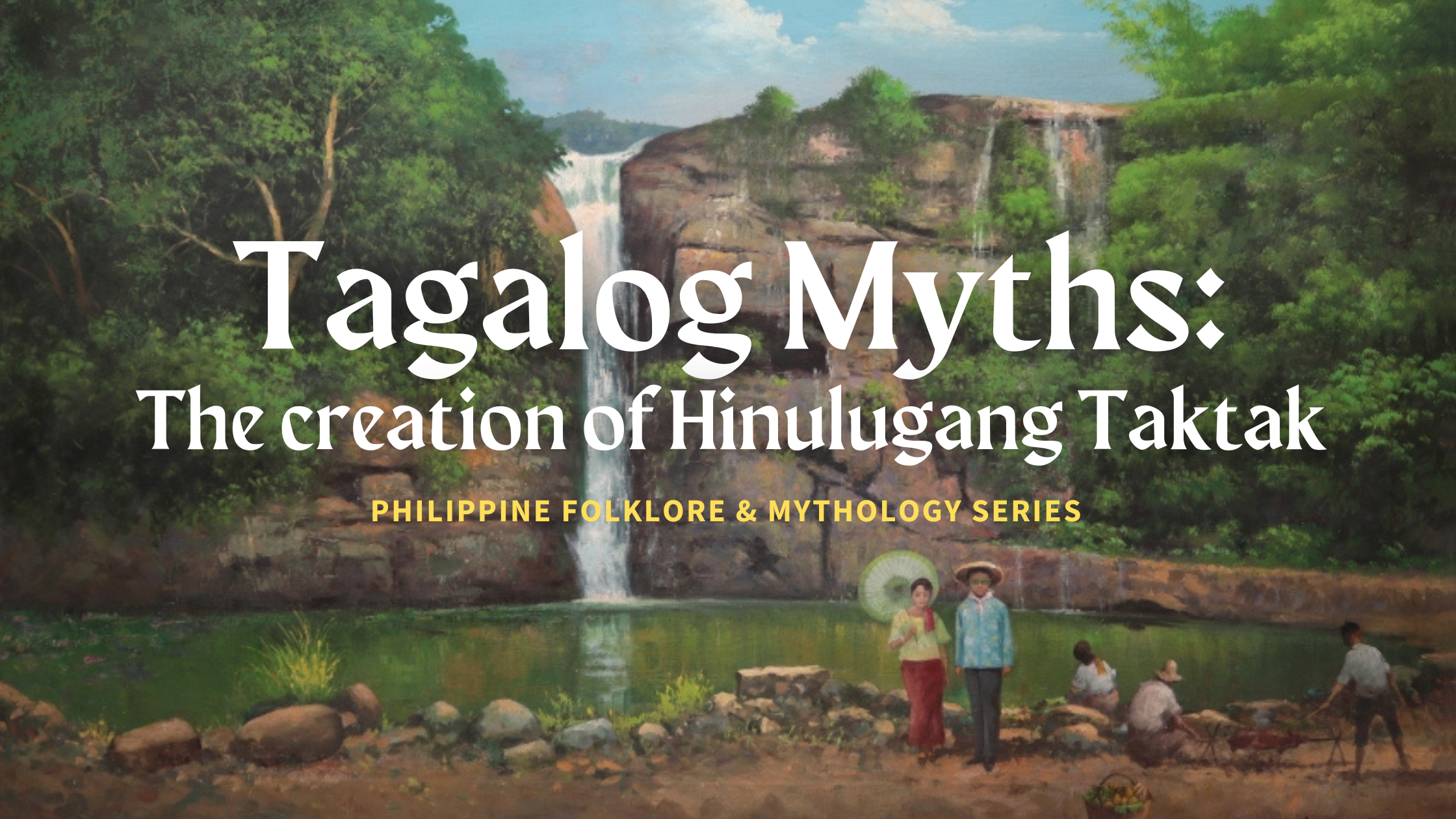
This particular folklore is from Antipolo, Rizal Province in Luzon. It talks about the creation of Hinulugang Taktak, a popular waterfall in Antipolo, and a protected national park. Today there are several folk tales regarding the waterfall, such as a large bell that was thrown into the waterfall sometime in the 15th or 16th century because the locals thought it was too loud.


But this tale is much older and is practically unknown to folks today. It involves everything that one can find in a classic epic from the Philippines. A story of love, the spirits, anito, deities, men fighting for the love of a beautiful woman. To be honest, it’s such a classic example, that I truly do believe this folk story, while summarized, was actually once an elaborate epic that probably took hours to chant and recite.
And just like how it was passed down, this story was passed down from several elders in the local community of Antipolo, back in the early 1900s. Even then, the story was already widely unknown, but it was passed down from these elders to a writer who interviewed them and published the folk story in an old local newspaper called, “Philippine Touring Topics” in November of 1934. This was an old pre-World War II magazine that was published in the Philippines. Most of the volumes are hard to find and are collectors items now. It was mentioned and written by a N.U. Gatchalian, who heard about this story, what once may have been an epic, told to them by several of the older locals in the area at the time whom they interviewed.

It was then later published in “Philippine Folk Literature: Myths” in 1994 by Damiana L. Eugenio, the mother of Filipino Folk Literature. She was a professor and author of several books regarding folklore, myths, and folk beliefs from the Philippines. You can find a copy of the updated edition of the book, together with the rest of the books in the Philippine Folk Literature series, with the University of the Philippines Press, where it’s published.

Here is the folk story based on the entry in “Philippine Folk Literature: Myths”, story number 92 in the book.
Long ago, there was a beloved chieftain named Ka-likasan and his beautiful daughter Liwayway. Her beauty was like the sunrise and her smiles were as sweet as the scent of ylang-ylang and camia. She was considered the most beautiful woman, her beauty and charm reaching across the islands, seas, mountains. She was even known to the spirits of the mountains, lakes, and rivers, and among the deities.
Among her many suitors were Malalim, the spirit of the lake, who wooed her from morning until night. There was La-am, the spirit of the river, who forever sang to her his love eternal. Banaag, the god of the mountains, whispered his heart’s desires to her. Lastly, was Sikat, a son of the supreme deity, Bathala. Everyone tried to woo Liwayway, telling her their love for her, their power, wealth, and kingdoms, all to try and win her heart. Liwayway only answered with sweet smiles to each of them, as she couldn’t decide who she wanted to give her heart to.
One day, the village of Ka-likasan and Liwayway held a festival in honor of Liwayway’s birthday. The village felt so fortunate and favored by the gods. The spirit of the river, La-am, gave them plenty of fish. Banaag, as god of the mountains, gave them fruits and other products from the forest. Bathala, the father of Sikat, never showed his wrath and violence upon them. The village danced and reveled, celebrating the beloved Liwayway.
The suitors lined up and gave their gifts to Liwayway. Malalim, the spirit of the lake, gave her a drinking cup made of the best shells from his realm. La-am gave all the fishes in the stream. Banaag, the richest of the suitors, gave her a golden crown, the wealth of his mountain. His subjects labored many years to perfect it in order to be fit for her. Sikat however, offered only his heart as his present.
Out of all the presents, Liwayway liked the crown the best. However, upon receiving the gold crown Liwayway forgot everything. She spurned the spirit of the river, spirit of the lake, and Sikat, rejecting them and leaving them with broken hearts. La-am, the spirit of the river, vowed to avenge his disappointments before he left. But Liwayway only gave him a smile.
Every morning, Liwayway went to the river with the crown on her head, admiring herself in the reflection of the river. One day, as she bent her head to see her image in the water, the wind blew off the golden crown and it fell into the river. As she cried for help to get the crown, laughter was heard from La-am. He got his revenge.
“Never will you find the crown you liked so well! It fell into my kingdom and unless you promise to marry me, it will never be recovered,” the river spirit said.
Angry, Liwayway yelled, “No, I’ll never marry you! I’ll have the crown recovered even if it will destroy your treacherous stream!”
She left hurriedly. When she reached home she saw Sikat waiting for her. Here was the man who would do anything to win her favor. She would ask him to recover for her the lost crown. And when she divulged her plight, Sikat readily consented on the condition that if he recovered the crown she loved so well, she would be his wife. To this she agreed and to prove that she really meant to marry him, the both of them swore an oath before the god of their anitos.
Sikat departed, his heart intoxicated with joy. Liwayway would be his. To the kingdom of his father Bathala, he would bring her. The task which he swore to perform for the sake of Liwayway was easy, he thought. For under his command was the omnipotent power of his father.
There were also his cousins, the anito Kidlat (lightning) and Kulog (thunder), who he would invoke for their help. So he prepared everything to recover the crown, in order that he might realize his dream to marry Liwayway.
Liwayway was ready to marry him because she loved him from the very beginning. But as she sat by the window thinking of Sikat, the god of the mountain, Banaag, came to claim her as his wife. That was her promice and her father’s: the marriage in exchange for the crown. However, she refused to marry and go with Banaag, for she already made a sworn vow and oath before the god of her anitos that she would only marry Sikat. When Banaag heard of this, he became furious and demanded the return of his gift, however she could not for it was in the river, somewhere in La-am’s realm.
“Oh, fairest princess, you have betrayed my confidence and my great love for you,” Banaag exclaimed in contempt.
“Greatest, oh, wealthiest of the spirits, I pray that you come back a week from now, and the crown you gave me will be returned. Sikat has promised to recover it for me,” Liwayway explained.
Banaag was not appeased. He wanted Liwayway more than anything else. But he dared not to anger the anitos.
“By the power of my father, oh benevolent spirit of the mountains, I promise to return to you the crown you gave my beloved.” They heard Sikat reply who approached them.
“If you fail, oh, son of the powerful Bathala, I will take Liwayway as a hostage until the time when you recover the crown I prized so much. A week from now, I shall come back for my lost crown.” After saying this he disappeared. Sikat comforted his beloved, by telling of his hope to recover the lost crown of Banaag.
And so did the work begin. Servants of Bathala began the search for the crown, which was hidden by La-am. Days and nights they searched in vain. On the 7th day, the spirit of the lake, Malalim, whispered to Sikat that La-am had hidden the crown beneath the river where it fell. Sikat then ordered the spirits to dig and dig in the place where it had fallen. Sikat also implored La-am to tell him where it was, but he refused. Days went by and the crown was still lost.
Sikat returned to the village of Liwayway to wait for Banaag, whom he would ask for more time. To his surprise however, the village was desolate. The chief, Ka-likasan was dead, and his beloved daughter, Liwayway, was forcibly taken by Banaag. In rage, Sikat ordered his cousins, Kidlat and Kulog, to destroy the village and trees in Banaag’s kingdom, and to help the spirits and servants of Bathala to punish the river of La-am. He then ordered the spirits to continue digging until the place where the crown fell became very deep, and the river was destroyed as La-am’s punishment.
The river of La-am was cut and its once straight course dropped into a deep ravine. Still, the crown couldn’t be found. Far and wide the spirits dug that deep portion of the river, but there still was no trace of the crown. La-am, still refused to admit where he hid it in the river. After much time, the river was transformed into a waterfall, the part unaffected by the digging became shallow. From the wrath of Sikat, to the digging of the spirits in the river, to the work of his cousins Kidlat and Kulog, the once beautiful, proud, and strong river formed into Hinulugang Taktak. The sight of it appeased Sikat a little, but he was still lost without the sight of the crown and his love.
Sikat then ordered the spirits to stop digging at the site, for he knew it would be useless. He vowed to make a vigilant search for the lost crown once in a hundred years when there was a full moon hanging low in the sky. He believed that he would be able to catch La-am playing with it under the moonlight.
Unless Sikat could recover the crown, his beloved Liwayway would never be released and free from Banaag. Such was his great love for her, who eventually became the goddess of the mountains against her will. Only through the return of the lost crown of Banaag could he claim and free Liwayway.
Sikat vowed that the waterfall of Hinulugang Taktak would remain as such until the crown was found. Once his mission is realized, the Hinulugang Taktak would disappear, according to old folks who know the legend.
The Hinulugang Taktak is the scene of love and romance of a legendary past; so it has become popular to young men and women who have fresh dreams of love.
What are your thoughts on this piece of Tagalog folklore?

You might also like